PTSD has no specific individual in mind. It could happen to anyone at any given moment. Regardless of your culture or how you choose to live your life PTSD can affect you. A disorder such as this often carries a lot of baggage that’s needs to be managed. Our team dove into the dramatic montage of stories of Kate Ryan, a sexual abuse victim, and Christopher Allen, a veteran in drone warfare.
For Kate, being a victim of sexual abuse has consequently affected her social life and self-esteem. After being raped by a member of her mutual circle, Kate turned to a few friends in that circle seeking help; however, her friends disregarded the incident and continued to be friends with her rapist. Isolated and forgotten, Kate expressed that “it didn’t seem to matter that this person that was in both of our lives had done this.” She now believes, “There are no social consequences to raping a friend.” People who resist to keep their troubles to themselves, referred to as ‘troubles resistance,’ are subjected to feel isolated from others, ultimately refusing to seek help.
For Christopher, stalking and bombing his enemies thousands of miles away from a monitor screen had costed the lives of many innocent civilians and, furthermore challenged his moral beliefs. Christopher says, “Because you’re killing people not only that you’re not necessarily sure are trying to kill you — you’re killing them with absolute impunity.” These targeted-killing orders takes a toll on drone soldiers and furthermore, disconnect them from right or wrong.
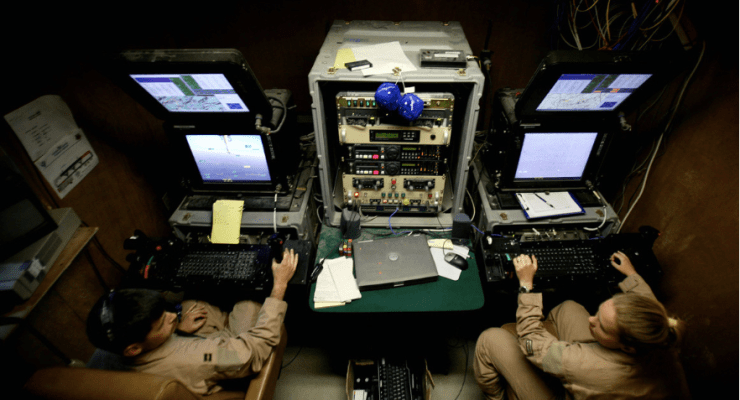
Two drone officers managing the skies through their monitors
When referring to the similarities, both individuals experience interpersonal uncertainty, or lack of connection towards people who are close to you. Kate Ryan experienced on the feeling of isolation and loss of friendship to express her condition. Similarly, we observed that Christopher Aaron was unable to speak out about his anxiety and condition, exclusively with his relationship with God. Both Ryan and Aaron possess similar models of health and illness. Being apart of war is one of the hardest decisions in life. Finding the strength to continue on after a sexual assault is just as hard.
“At night, he dreamed that he could see — up close, in real time — innocent people being maimed and killed, their bodies dismembered, their faces contorted in agony.”
– Eyal Press on Christopher Allen
While both individuals struggled to find direction in managing their PTSD, their types of supportive behaviors are different. Because Kate experienced no emotional support from her friends, it led her to isolation and furthermore, depression and anxiety. Christopher was falling to receive important informational help to correctly manage his experience. He didn’t know where to get help to treat his symptoms that were giving him night chills, joint pains, and nightmares. He met with several health providers that couldn’t help with condition, so he turned to forms of instrumental health such as yoga, Chinese herb medicine, and fasting.
Today, Kate and Christopher continue to manage the spiraling effects of PTSD and have bravely chosen to speak about their illness through these articles. For Kate and Christopher, they avoided confronting their PTSD which created a snowball effect of negative issues. If you have any kind of condition, talk to someone you love, they will understand.
Foundation of America Hotline for PTSD veterans: (877) 717-7873
This toll free hotline is available 24/7
References

Ryan, K. (2018, July 11). Surviving the Long-Term Trauma of Sexual Violence. Retrieved from https://www.nytimes.com/2018/07/11/lens/surviving-the-long-term-trauma-of-sexual-violence.html

Press, E. (2018, June 13). The Wounds of the Drone Warrior. Retrieved from https://www.nytimes.com/2018/06/13/magazine/veterans-ptsd-drone-warrior-wounds.html
 Post-Traumatic Stress Disorder